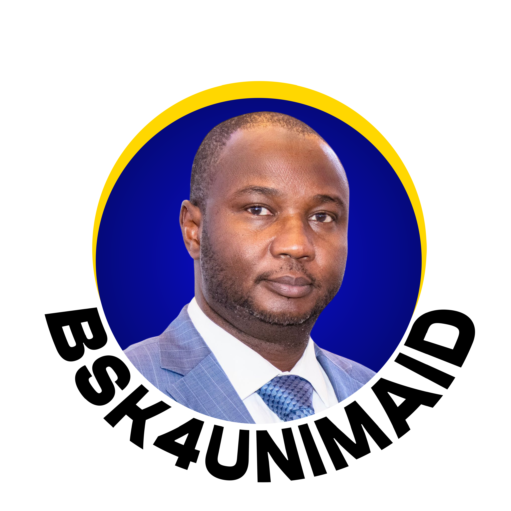
Unity in Structure. Impact in Action.
The Man Who Built the FCT Chapter is Ready to Build the Global Body.
About BSK
Baba Shettima Kukawa is a seasoned downstream oil and gas professional with over 20 years’ experience, including 17 years in retail sales, marketing, and brand management. He is the Executive Director, Retail Operations and Mobility at NNPC Retail Limited, overseeing retail and marketing activities across a network of over 1,000 stations and driving revenue growth and market expansion.
His expertise spans sales, brand development, network optimization, promotional campaign management, and stakeholder and contract negotiations. He is also recognized for relationship-building and leading transformative business development initiatives.
Beyond his corporate roles, he has provided extensive leadership within the Alumni Association, serving as Director, ICT (FCT Chapter) (2007–2009; 2009–2012), Pioneer National Exco Member (2012–2013), FCT Chapter Exco Member (2013–2015), Ex-Officio (2015–2019), and Chairman, FCT Chapter (2019–2023). His key contributions include developing the Association’s website, serving on the constitution drafting committee that enabled formal registration with the CAC, and leading a high-performing FCT Chapter widely regarded as a model for other chapters.
He was also the pioneer Branch Chairman of NNPC Retail PENGASSAN and served as a member of the National Working Committee from 2015 to 2018.
Across these roles, Baba has consistently demonstrated strong leadership in building high-performing teams, managing diverse and multi-disciplinary groups, strengthening collaboration, and leading with innovation to deliver measurable outcomes.
He is an alumnus of the University of Maiduguri, Lagos Business School, and Harvard Business School, with professional certifications, membership of the Nigerian Institute of Management, and fellowship of the National Institute of Marketing of Nigeria. He serves on the boards of NNPC Retail Limited and NNPC Shipping Limited and is known as a mentor committed to excellence, innovation, and transformative leadership.






The Manifesto
01.
— CAPACITY: THE EVIDENCE OF STEWARDSHIP
“Do notjudge me by what I say. Judge me by what I have done.”
My competence to lead the Global Association is not theoretical; it is evidenced by a track
record of delivery. Below are key milestones from my stewardship ofthe FCT Chapter not
as stories, but as verifiable outcomes.
02.
— THE ROADMAP: FROM UNITY TO IMPACT (2025-2027)
My vision for the Global Association is anchored on two strong pillars:
1. UNITY – The Structure
2. ІМРАСT – The Value and Legacy
These pillars are not slogans, They translate into specific initiatives, timelines, and
measurable outcomes.
03.
— The "Back to Source" Database Strategy
The Solution:
We cannot build a serious global network without a serious database. We must know
who and where our people are.
The Actions:
• Data Partnership with the University:
• Global Alumni Database
04.
— The "Grid" Engagement System
The Structure:
We will create a Grid of Department-Year Representatives, e.g.:
• “Law Class of ’99 Rep”
•”Engineering Class of 2005 Rep”
• “Mass Communication Class of 2010 Rep”
05.
— Formalizing Institutional Units
We will pursue constitutional amendment to formally recognize “Institutional Units” in
major MDAs and large organizations (e.g., UNIMAID Alumni First Bank Unit, UNIMAID
Alumni CBN Unit, etc.).
06.
— The Global Mentorship Grid
We will launch a structured Global Mentorship Program that connects the Town
(Alumni) with the Gown (Students and Young Graduates).
Impact Stories
STRUCTURE & GOVERNANCE
He Didn’t Promise Change — He Built the System
As FCT Chapter Chairman, BSK introduced what many alumni bodies lacked: a written, measurable Blueprint. In 2019, the FCT Exco published a strategic plan that guided decisions, assigned responsibilities, and tracked results. This Blueprint was not symbolic — it led to the Maiden Annual General Congress in 2022, firmly rooting leadership in constitutional governance rather than improvisation. Transparency was strengthened through newsletters and active communication channels, restoring trust and accountability.
UNITY & MEMBER ENGAGEMENT
Unity Was Not a Slogan — It Became a Culture
Under BSK’s leadership, unity moved beyond election-day rhetoric. The Reunion Walk Series was institutionalized, with 7 editions during tenure and 2 more after, even when alumni engagement was low nationally. Annual picnics became a strategic reconnection tool, not just social events. These gatherings reactivated dormant members, rebuilt pride in UNIMAID identity, and transformed a fragmented alumni body into a living, connected community.
REBRANDING ALUMNI PRIDE
He Made Alumni Participation Attractive Again
The FCT Chapter redefined alumni engagement by blending purpose with pride. World-class picnics featuring top entertainers and UNIMAID-made hosts repositioned the association as vibrant, relevant, and worth belonging to. Attendance surged, disengaged members returned, and alumni once “checked out” reconnected with their roots — not through pressure, but through value.
INTELLECTUAL CAPITAL & CAREER GROWTH
From Social Network to Knowledge Network
BSK shifted the alumni narrative from social bonding alone to career and intellectual advancement. High-impact webinars and sessions brought together distinguished professionals across law, engineering, finance, entrepreneurship, and academia. These engagements created mentorship pipelines, inspired younger graduates, and positioned the alumni association as a platform for growth, not just nostalgia.
ECONOMIC EMPOWERMENT
Alumni Supporting Alumni — In Real Terms
For the first time, the UNIMAID Alumni Marketplace was launched in Abuja, connecting alumni entrepreneurs directly with a trusted community market. This initiative moved the association from talk to tangible economic value, enabling members to do business with confidence and within the UNIMAID family.
DIGITAL TRANSFORMATION
Modern Leadership for a Modern Alumni
BSK introduced QR-code–based dues payment and event registration, simplifying participation and signaling a shift toward digital efficiency. This wasn’t just about convenience — it was a declaration that UNIMAID alumni leadership can be innovative, transparent, and future-ready.